Comments

Valid email addresses are required to post comments. If your comment is not posted, I will send you an email with an explanation.


Friday, March 8, 2013

We Are "How" We Read

Last week, on my way home, I listened to an interview on the local National Public Radio station. A book reviewer was chatting with an author of a book (Gary D. Schmidt: Okay for Now) intended for middle school readers. The author was describing the plot of the book and fleshing out the attributes of its main character, a fourteen year old boy. As I listened I was struck by how the boy perceived a picture of an Arctic Tern in a book he was reading in a manner that few others would interpret. The perspective was based on his particular station or condition in life at that point in time.
I came to the conclusion that we are not "what" we read, but rather we are "how" we read. Here's an excerpt from the radio interview, courtesy of NPR.

"Fourteen-year-old Doug Swieteck seems to be stuck between a rock and a hard place. He has just moved to a new town, where he doesn't have any friends, and where his teachers — and the police — think of him as nothing more than a "skinny thug."
So it's easy to understand why Doug, the protagonist of our latest book for
NPR's Backseat Book Club, Okay for Now, is anything but a happy-go-lucky kid.
"He has a beat-up situation, a beat-up family, a beat-up house," author Gary D. Schmidt explains to NPR's Michele Norris. "And he comes to a new town, trying to find a new way to start. But he brings all of his beat-upedness with him."
 
Eventually, Doug finds his way to the local library, where he discovers a beautiful edition of John James Audubon's Birds of America. When he notices that nine of the pages with plates of birds have been cut out with a razor blade, he resolves to track them down.
"Doug, who is so beat-up, wants one thing in his life, just one thing in his life, that's whole," says Schmidt. "He has no resources, no way to do it, but he's determined to try and get all nine of those plates back. So this is a novel about this kid trying to do that, surrounded by people who come to love and cherish him."
One particular bird in the Audubon book, an Arctic tern, makes a profound impression on Doug:
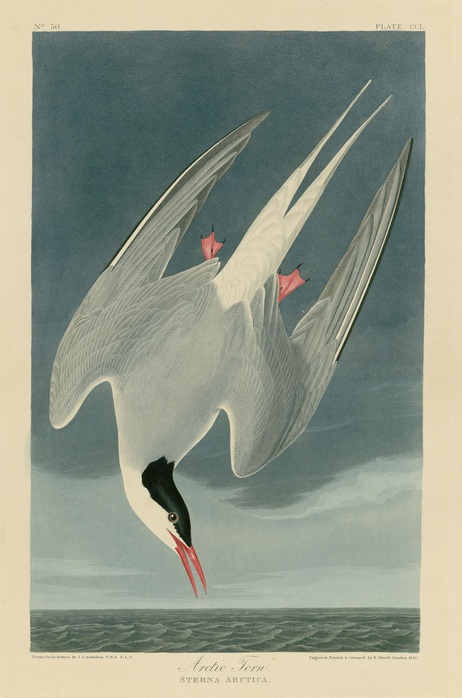
The "Arctic Tern" from John James Audobon's Birds of America makes a profound impression on Doug, the protagonist of Okay for Now.

The "Arctic Tern" from John James Audobon's Birds of America makes a profound impression on Doug, the protagonist of Okay for Now.

Courtesy The Audobon Society
He was all alone, and he looked like he was falling out of the sky and into this cold, green sea. His wings were back, his tail feathers were back, and his neck was pulled around as if he was trying to turn but couldn't. His eyes were round and bright and afraid. And his beak was opened a little bit, probably because he was trying to suck in some air before he crashed into the water. The sky around him was dark, like the air was too heavy to fly in. This bird was falling, and there wasn't a single thing in the world that cared at all.
Of course, Doug's hopeless interpretation is about much more than just the bird. It's a communion, of sorts.
"He looks at that picture and he sees his own life," says Schmidt. "He sees a bird or a living thing that's so beautiful falling out of the sky with nothing to support him at all. And in reality, the bird isn't falling out of the sky. He's going down to get something to eat. But Doug's perception is that he is alone and in trouble."

I found myself reminiscing of my favorite books as a learner and gregarious reader in middle school. The first two immediately popped up as an almost reflexive action without thinking. Robinson Crusoe, by Daniel Defoe, and Island of the Blue Dolphins, by Scott O'Dell. A moment later I realized the parallels between the two books. Each focused on someone being stranded on an island and enduring challenges to their survival.

At that juncture of my life, on the threshold of adolescence and mired in the confines of an impoverished family of nine, I felt that I was on an uncharted, isolated island of sorts fighting for survival. I certainly don't recall consciously being drawn to the books for that reason.

I did eventually persist and escape the deserted island of my childhood and enjoyed new vistas and expanded opportunities. Now, I have collected countless memories of serving others in a lengthy career centered on making a positive and constructive difference in the lives of others through my efforts as an educator. 

Interestingly, that career arc began on a small island off the coast of Maine (teaching fifth grade in Stonington, a small village on Deer Isle) and will end on a small "island" in upstate New York (as superintendent of the school district in Green Island). In between, I worked as a principal in Amarillo, Texas, a veritable island of 200,000 people in the Panhandle of Texas surrounded by the vast and empty plains without another town of over 20,000 people within a hundred mile radius.

In a way, unlike Robinson Crusoe and Karana, I have chosen to remain and flourish on these islands.


Tuesday, February 26, 2013

from Brick and Mortar to Click and Order

The transformation of schools and instructional delivery systems is a challenge that is characterized by the clash of the past ("brick and mortar") and the present ("click and order").

At my age, I can remember film strips featuring social studies and science information with pictures and accompanying narratives, vinyl records for music class, SRA kits for Reading, the enviable chore of cleaning the chalkboard erasers, and many more memories.

I recall how exciting it was in 1982 to open boxes containing brand new Vic Commodore 20 computers and later Commodore 64 version. Wow, it was unbelievable what those units could do! And the hand held calculators that replaced the large boxy desktop calculating machines? How would have thought? Digital watches, are you kidding me? During a break in a conference I attended in 1991 I felt compelled to inform a friend of mine who was a presenter that the people at my table were so curious and intrigued by how he was delivering information that unless he explained how PowerPoint worked they would unconsciously allow the messenger to obscure the message.

And today, I also grapple with social media, interactive white boards, informative youtube videos, tablets, and a host of other new and exciting technological learning instruments.

It's been a thrilling roller coaster ride across nearly four decades in education.

Here's a four minute video on 21st century education that is both scary for those secure in the past and promising for those anxious to chase the future.

http://www.youtube.com/watch?v=O35n_tvOK74

Monday, February 11, 2013

40 Minutes: 40 Years Later

I enjoy the study of history and the story of civilization.

History was my favorite subject throughout high school. My interest in famous events, people, places, and pivotal points in our civilization prompted me to extend myself well beyond the confinement of a 40 minute period each day of school. However, I graduated from high school 42 years ago this June and despite the exponential growth in the content of social, economic, political and military issues, our learners today still have a single 40 minute period each day to study and learn about all of the important historical information I had to learn, plus whatever has happened in the world or our nation since I graduated. Think about it. The same can be said about Literature, and especially Science, a discipline that has experienced an incredible growth in content and skill.

How can you do it? How can we squeeze the ever-growing body of knowledge available today into the same amount of time that learners had generations ago? What is of most importance? Surely, you can't expect that the learners of today are learning everything I was expected to learn 42 years ago AND everything that has occurred since then! So, what is left out? Who decides what is left out?

Educational researcher Larry Lezotte refrred to the process of organized abandonment. He cited the overwhelming burden facing schools with an expansive curricula delivered in a fixed and finite amount of time. He discouraged people from adding anything to the curriculum unless something is eliminated in kind, so we no longer try to pour ten gallons of water into a five gallon container.

The question remains - who decides and how do they decide?

Friday, February 1, 2013

The Crossing Guard

Despite the frigid weather, with a wind chill dropping the temperature to five above zero, many of our secondary level learners patiently lined both sides of the street in front of our school today. They were paying tribute to the former crossing guard who not only shepherded them safely across the busy intersection adjacent to the school, but also performed the same ritual for most of their parents.

Dorothy "Dot" Jordan passed away on Tuesday. She was in her eighties when she retired at the end of the 2010-11 school years following thirty-four years as a crossing guard in Green Island stationed at that same traffic intersection. During that time she fulfilled her duty no matter the weather. Her last year as crossing guard coincided with my first year as superintendent. I shared her post, separated by ten or fifteen yards as I welcomed our learners into school each morning.

I marveled at her resilience and her compassion for children. She bore seven of her own. In addition to her position as a crossing guard she also worked as a seamstress. There were times when I met her in the morning with a pair of pants that needed to be hemmed or some other modification. She always smiled and waved to me each morning. She knit mittens for many of the younger children and gave them small gifts just before breaking for the winter holidays. She had candy treats for them at Halloween. She could be counted on each and every school day to diligently watch over those navigating that intersection. She was consistently cordial to all and persistently dedicated to her responsibilities.

Her generosity has extended beyond her years. Rather than flowers, her family had requested that contributions be made to the "Mrs. Jordan's Kids" program to benefit young children at Heatly School who may need a helping hand. She was that special.

In her honor, three of the members of our senior class served as honorary crossing guards, ushering the hearse and funeral procession through that very same intersection outside our school while other learners stood solemnly as they flanked the road and watched the parade of vehicles slowly advance. It was a fitting tribute in the memory of someone who served the children of our community for over three decades.

Good bye Dot, and thank you for all you've done for the kids of Green Island.

Tuesday, January 29, 2013

Touching the Future

“I touch the future. I teach.”
― Christa McAuliffe – Teacher and Astronaut, from Concord, New Hampshire

I have also endeavored to touch the future throughout my lengthy educational career. Despite many struggles, I have pressed forward in an ongoing attempt to positively influence the lives of others and make a difference in their lives as they develop and invent their own futures. I believe all good teachers have that commitment as a common denominator.
January 26, 1986 marked the last day of Christa McAuliffe's life - but it did not end her influence on others. That was the day that NASA sent the first teacher aloft in orbit aboard the Space Shuttle Challenger.

Tragically, the Space Shuttle Challenger (mission STS-51-L) broke apart 73 seconds into its flight, leading to the deaths of all seven crew members, including teacher/astronaut Christa McAuliffe. It was a heartbreaking scene captured on live television for the millions who watched the launch. The spacecraft disintegrated over the Atlantic Ocean, off the coast of central Florida at 11:38 EST (16:38 UTC). The fate of the vehicle began to unravel after an O-ring seal in its right solid rocket booster (SRB) failed at liftoff. The O-ring failure caused a breach in the SRB joint it sealed, allowing pressurized hot gas from within the solid rocket motor to reach the outside and impinge upon the adjacent SRB attachment hardware and external fuel tank. This led to the separation of the right-hand SRBs aft attachment and the structural failure of the external tank. Aerodynamic forces promptly broke up the orbiter. (wikipedia)

I watched in horror as the spectacle occurred on television. I was in my fourth year as an elementary principal in the Amarillo Independent School District in Amarillo, Texas. It was a shocking scene that immediately produced turbulent emotions. Countless educators across the country had joined in enthusiastic anticipation of the incredible experience that awaited this first teacher-astronaut in the time leading up to the actual launch. I was an educator who sensed the importance of a teacher granted the privilege to participate in the ongoing process of discovery sponsored by NASA. The fatal accident was received like a collective punch to the stomach to all those who watched those 73 seconds of flight and the silence of the television announcers covering the launch and the horror that soon followed when it became apparent that something was terribly wrong.

Fifteen years later NASA experienced another tragic mishap when the Space Shuttle Columbia burst apart on February 1, 2003 while reentering earth’s orbit, killing all seven crew members.

The loss of Columbia was a result of damage sustained during launch when a piece of foam insulation the size of a small briefcase broke off from the space shuttle external tank (the 'ET' main propellant tank) under the aerodynamic forces of launch. The debris struck the leading edge of the left wing, damaging the Shuttle's thermal protection system (TPS), which shields the vehicle from the intense heat generated from atmospheric compression during re-entry. (wikipedia)

This last October, many years after moving back to New York,  I returned for a brief visit to Amarillo. At that time I was again reminded of the potential influence a teacher can make as well as the sacrifices made by those determined and courageous adventurers who seek to stretch the boundaries of our known world through discoveries. Not long after the 1986 Challenger disaster and well before the 2003 Columbia tragedy, astronaut Rick Husband commemorated the loss of the Challenger crew and reminded children who were mourning the death of Christa McAuliffe, America's teacher, that progress and discovery are often the result of courage and sacrifice. The price of advancement can at times exact a heavy toll, but we must sustain our commitment if we expect to improve life.

The truth, and irony, in those words were never more true than when my plane touched down in Amarillo and successfully landed at Rick Husband International Airport, the airport named in memory of Amarillo native Rick Husband, commander of the ill fated Space Shuttle Columbia. 

Wednesday, January 16, 2013

Superintendent and Supernintendo

I was on the phone soon after 5:00am this morning with two superintendents of school districts adjacent to ours to discuss the weather and how it might impact the operation of school today. We determined, based on reports that the area would receive only 2-4 inches of snow and the temperatures would likely rise to 35 during the afternoon, that we would all maintain normal school hours today.

The thought of snow days and school cancellations takes me back perhaps a dozen years ago to a conversation I had with children sharing their lunch-time with me when I was a principal. On that particular day we were joined by the superintendent of the school district. The kids weren't familiar with the title of superintendent and had likely never heard the word before so they asked who he was and what role he served. As he explained many of his responsibilities to the young children he casually mentioned that he was the only person who could decide to close school. The kids liked that since they always enjoyed an unexpected day off of school.

Now, I must point out that I always ask the kids who eat lunch with me what they want to be when they grow up. I also have to remind you that at the time of this incident Nintendo video games were extremely popular. Well, when it came time for one first grade boy to announce his intended occupation, he pointed to the superintendent and proudly exclaimed that he wanted to be a supernintendo, just like him, so he could close school whenever he wanted.

It was just a matter of a few letters that separated superintendent and supernintendo, but there are days when the myriad bureaucracy and paperwork make my job seem like it is a game.

Stay warm and drive safely on the snowy roads.

Tuesday, January 15, 2013

Budgets and Bullets

Tragedies of the magnitude of mass shootings in our schools attract instant attention and nearly as quick reactions in the form of proposed policies and renewed debates on school safety and gun control. This Blog entry is not meant to engage in any discussion on gun control, but rather an examination of other issues involved in these heinous crimes and what schools must consider in an effort to ward off repeated instances of school shootings and loss of life.

While the setting of the recent killings at Newtown is atypical, in that it was an elementary school whereas most of the shootings have occurred at high schools, nonetheless, the profile of the shooter remains fairly typical of the profile for perpetrators of this crime. That is, based on news reports the shooter was a male who was a social loner and perhaps suffering from some emotional or mental health issues.

Set aside the heated words that quickly evolve in any conversation on the second amendment rights to bear arms. Let’s look at the common traits of the shooters. Absent guns in the strictest of gun control legislation, we still have males aged 15-20 who exist uncomfortably outside the social circles of their peers and battle emotional and mental health concerns. While the schools cannot impact gun control, they can exercise efforts to address the issues surrounding these disenfranchised males who eventually reach such a flash point that they are determined to end their own lives after exacting injury and death upon others. The DASA (Dignity for All Students Act) legislation enacted in the state of New York on July 1, 2012 is designed to reduce and eliminate bullying in schools. That's certainly a start in the right diretcion.

Klebold and Harris, the infamous duo that spread death throughout Columbine High School in April of 1999, were later found, through analysis of their journals and computers, to harbor resentment toward those classmates who operated within the more visible and popular social groups in public high schools (i.e. athletes,..). Revenge was a contributing factor in their actions. They felt invisible, detached and inconsequential. They were reportedly picked on by others at school. They were unaffiliated with any organized school sponsored program beyond being names on a class roster.

There are many different and interesting extra-curricular groups that exist in most high schools. The most public and the largest of these groups tend to be athletics, the expanse of which is related to the size of the school. According to Jason Koebler, writing for US News, (http://www.usnews.com/education/blogs/high-school-notes/2011/09/02/high-school-sports-participation-increases-for-22nd-straight-year)  “More than 7.6 million students played sports during the 2010-2011 school year, an increase of nearly 40,000 students compared to 2009-2010. The organization estimates that 55.5 percent of all high school students play a sport.”
In addition, there has been a wide array of other activities made available at most high schools, often depending on the size of the school and available funds. For instance, there is Student Council, National Honor Society, Debate Clubs, Foreign Language Clubs, Community Service, Yearbook Club, School Newspaper or Journalism Club, as well as a variety of Music offerings such as Band, Chorus, and Orchestra, and other possibilities too numerous to list. It should be noted that learners with a voracious appetite for engaging in extra-curricular activities result in a duplication in the percentage of participants (i.e. an athlete who is also a member of Student Council).

This brings me back to the profile of a school shooter. The perpetrators have generally not been affiliated with such extra-curricular experiences, but rather loners who have felt excluded from them, either because of an inability to qualify for them or a lack of interest in what was offered. We should examine opportunities to expand the reach of extra-curricular activities and create programs that attract learners who have interests outside of the usual menu of extra-curricular activities, but are presently unaffiliated with any school sponsored activity beyond attending classes.
However, the economic problems facing schools in the form of decreased funding, together with an increase in accountability, per state mandated assessments, have forced many schools to make difficult choices in allocating scarce resources that may result in funds being shaved from everything and anything not directly related to those subject areas tested. That posture leaves extra-curricular activities vulnerable to financial cuts.

Budget cuts not only deprive schools of the prospects of developing programs of interest to some of those seeking association but lacking any selections on the current menu of extra-curricular activities, but the safety net available for troubled teens is becoming smaller as well. Those staff members who attempt to address the needs of learners struggling with social and emotional problems (social workers, counselors,...) have likewise been subject to budget cuts. Unfortunately, it seems that the general factor in many cuts tends to relate to the degree of connection the personnel or program has with those areas contained within state mandated assessments. This is a potential dilemma or outcome of budget battles occurring in districts that have decreased programs and people to the point where they have been making decisions based on the lesser of evils. That is, mandated programs remain and non-mandated programs are vulnerable to reduction or elimination.

In sum, schools are simultaneously contending with two significant issues in the midst of a fiscal crisis that may not allow sufficient attention to effectively meet both areas of concern; 1) a clarion for higher performance on state mandated assessments; and 2) heightened anxiety about school security that is in part related to the potential negative impact of socially and emotionally troubled teens who feel disenfranchised and unsupported. How much longer can schools hope to "do more with less?"